Oven Heating Element Replacement Cost Calculator
Estimate Your Oven Repair Cost
Get an accurate estimate for replacing your oven heating element based on your specific situation.
Estimated Cost
If your oven isn’t heating up, or it’s taking forever to cook food, chances are the heating element has gone out. It’s one of the most common oven failures - and one of the easiest to fix. But before you grab a screwdriver, you probably want to know: how much does it cost to replace heating element in oven?
The short answer? Between $150 and $350 in New Zealand, including parts and labour. But that number can swing lower or higher depending on your oven model, where you live, and whether you do it yourself or hire someone. Let’s break it down so you know exactly what you’re paying for.
What’s a heating element, and why does it fail?
The heating element is the coil - usually at the top or bottom of your oven - that glows red-hot when you turn on the oven. It’s made of a metal alloy designed to handle extreme heat, but over time, it wears out. Every time you use the oven, the element expands and contracts. That constant stress causes tiny cracks. Eventually, it breaks. You’ll notice it’s not glowing at all, or only part of it is lit up.
Most oven elements last 8 to 12 years. If your oven is older than that, and the element has gone, it’s not a sign you’re doing something wrong - it’s just physics. Don’t assume it’s a power issue or a faulty thermostat unless you’ve ruled out the element first.
Cost breakdown: parts vs labour
When you pay to replace an oven element, you’re paying for two things: the part itself, and the labour to install it.
Parts cost: A standard oven heating element for a mid-range electric oven in New Zealand usually costs between $40 and $80. High-end ovens with hidden elements or dual-element systems (like fan-assisted convection ovens) can cost up to $120. You can buy these online from suppliers like TradeMe, Appliance Parts NZ, or directly from manufacturer sites. Just make sure you have the model number - it’s usually on a sticker inside the oven door or on the back.
Labor cost: Most appliance technicians charge between $80 and $120 per hour. Replacing an oven element takes about 30 to 60 minutes, depending on how easy it is to access. That means labour alone will run you $40 to $120. Some technicians have a flat rate for this repair - often $110 to $150 - which includes the call-out fee and the work.
So total cost? If you buy the part yourself and do it yourself: $40-$120. If you hire someone: $150-$350. The higher end usually applies to built-in ovens, wall ovens, or models with complex wiring.
Can you replace it yourself?
Yes - and many people do. It’s one of the few appliance repairs that doesn’t require special tools or certification. Here’s what you need:
- The correct replacement element (match the model number)
- A screwdriver (usually Phillips)
- Gloves (the element’s terminals can be sharp)
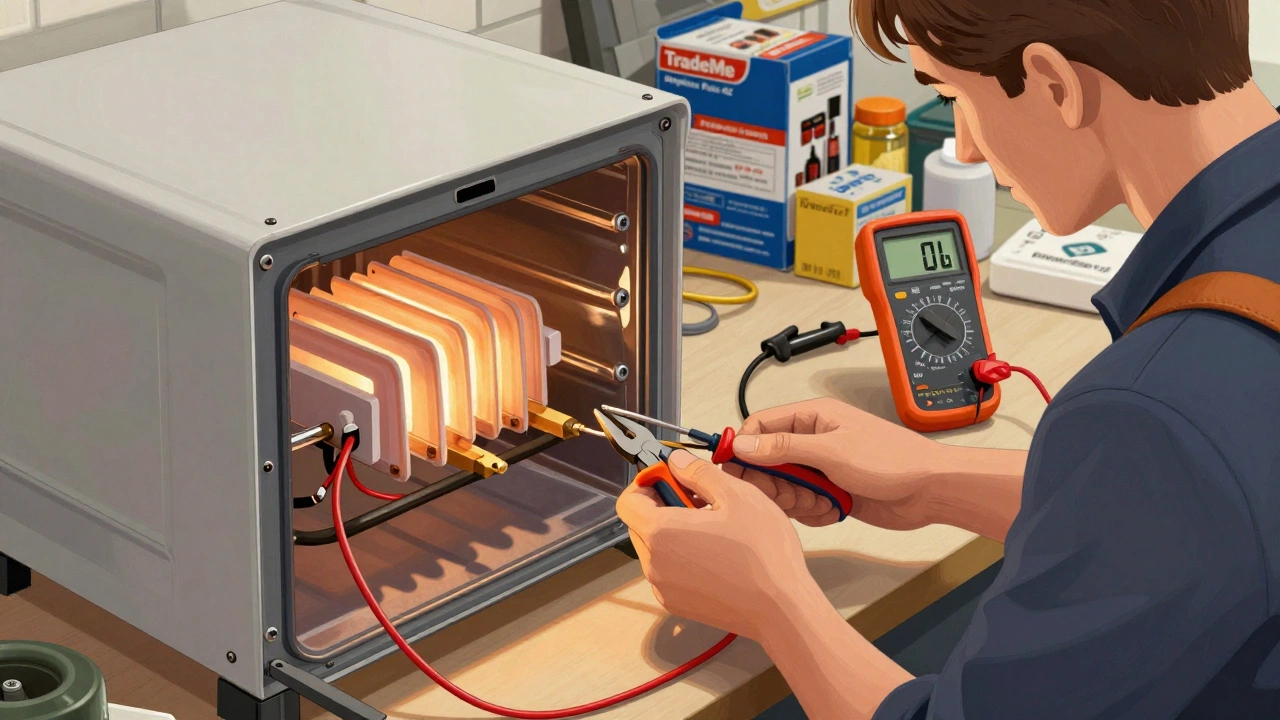
- A multimeter (optional, but helpful to test if the element is dead)
Steps are simple:
- Turn off the power at the circuit breaker. Don’t just unplug - ovens are hardwired.
- Remove the oven racks and any panels covering the element.
- Unscrew the element from the oven wall. It’s usually held by two or three screws.
- Disconnect the two wires attached to the terminals. Take a photo before you unplug them so you know how to reconnect.
- Plug in the new element, screw it back in, replace panels, turn the power back on.
That’s it. No soldering, no calibration, no guesswork. If you’re handy with a screwdriver, this is a 30-minute fix. And you’ll save at least $100.
But here’s the catch: if you mess up the wiring, you could blow a fuse, trip the breaker, or even damage the control board. If you’re unsure, or if your oven is older and the wiring looks frayed, it’s smarter to call a pro.
When to skip the repair
Replacing the heating element is worth it if:
- Your oven is less than 10 years old
- The rest of the oven works fine (fan, lights, controls)
- You can find a replacement part easily
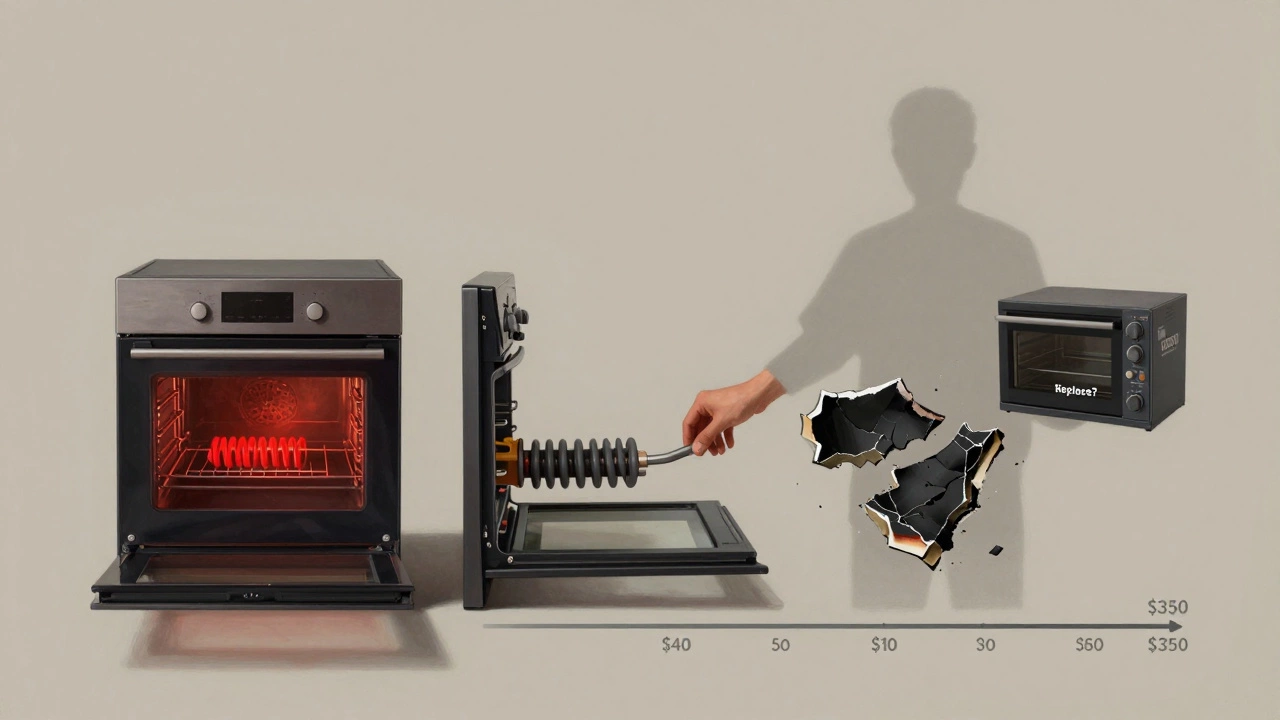
But if your oven is 15+ years old, and you’re spending $250 to fix one part, you might be better off replacing the whole thing. New mid-range electric ovens start at around $800, but they’re more energy-efficient, have better temperature control, and come with warranties. If your oven is struggling in other ways - uneven heating, strange smells, flickering lights - it’s probably time to upgrade.
Where to buy parts in New Zealand
You don’t need to go through a fancy appliance store. Here are reliable local sources:
- TradeMe - search by your oven model number. Many sellers list exact replacements.
- Appliance Parts NZ - offers nationwide shipping and has a searchable database by brand and model.
- Harvey Norman, The Warehouse - sometimes stock common elements for popular brands like Smeg, Electrolux, or Bosch.
- Manufacturer websites - Bosch, Samsung, and LG all sell replacement parts directly.
Always double-check the part number. A common mistake is buying an element for a fan oven when you have a conventional oven. They look similar but have different wattages and mounting styles.
What to watch out for
Some technicians will tell you the element is fine and blame the thermostat or control board. That’s not always true. A faulty thermostat won’t stop the element from glowing - it’ll just make the oven overheat or not reach temperature. If the element isn’t glowing at all, it’s almost certainly the element.
Also, be wary of inflated call-out fees. In Auckland, a reasonable call-out for a basic oven repair is $50-$70. Anything over $100 for a 1-hour job is steep unless you’re in a remote area.
And never buy a “universal” element unless it’s clearly listed as compatible with your exact model. These often don’t fit right, overheat, or melt.
Prevent future failures
Heating elements don’t usually fail suddenly - they give warnings. If you notice:
- Slower heating times
- One side of the oven cooking faster than the other
- Visible cracks or blisters on the element
That’s your cue to replace it before it dies completely. Waiting until it stops working entirely means you’ll be stuck without an oven during dinner prep or holiday baking.
Also, avoid slamming the oven door. The shock can stress the element’s mounting points. And clean the oven regularly - grease buildup can cause hot spots and shorten the element’s life.
Final cost estimate
Here’s a quick reference for what you’ll likely pay in New Zealand in 2026:
| Option | Parts Cost | Labor Cost | Total Cost |
|---|---|---|---|
| DIY (parts only) | $40-$120 | $0 | $40-$120 |
| Professional (standard oven) | $40-$80 | $80-$120 | $150-$200 |
| Professional (built-in/wall oven) | $80-$120 | $100-$150 | $200-$350 |
| Replace entire oven | N/A | N/A | $800-$2,500 |
Most people end up paying around $180 for a full professional replacement. If you’re comfortable with tools, you can do it for under $100. Either way, you’re saving hundreds compared to buying a new oven.
How long does it take to replace an oven heating element?
If you’re doing it yourself, it takes about 30 to 45 minutes. A technician will usually complete the job in under an hour. The time depends on how accessible the element is - built-in ovens with hidden elements take longer than freestanding ones.
Can I use a universal heating element in my oven?
It’s not recommended. Universal elements may look similar but often have different wattages, lengths, or mounting styles. Using the wrong one can cause uneven heating, damage the oven’s wiring, or even become a fire hazard. Always match the exact model number.
Why won’t my oven heat after replacing the element?
If the oven still doesn’t heat after replacing the element, the problem is likely elsewhere - the thermostat, temperature sensor, or control board. You may have installed the element incorrectly, or the wiring was damaged. Test the element with a multimeter before installing it, and double-check all connections.
Is it worth repairing an oven that’s 12 years old?
If the oven works well otherwise - no rust, no strange smells, no control issues - then yes. A $200 repair on a 12-year-old oven is still cheaper than replacing it. But if you’re having multiple problems, or your energy bills are climbing, it’s time to consider a new model. Modern ovens use 20-30% less energy.
Do I need to turn off the power at the breaker?
Yes. Ovens are hardwired into your home’s electrical system. Unplugging won’t cut the power. Always turn off the circuit breaker for the oven before touching any wiring. It’s the only safe way to work on it.